Monday, June 25, 2012
I'm back from my most recent trip to Mexico!
The trip was incredible and I have a ton of writing to do. I will also upload some new photos to the slide show, too! Stay tuned.....

Monday, April 23, 2012
The Santo Domingo Orphanage in Guatemala

Some people already know this but I have a soft heart and enjoy helping children all I can. I've never had children myself and it does not look very promising that I ever will. Who knows? I decided a few years ago to sponsor (4) girls at an orphanage in Santa Elena, Peten, Guatemala and I go visit them 2-3 times each year. Their names are: Kimberli, Brenda, Heydi, and Mishell.

In all, there are (38) girls between the ages of 4-18 years old who live at the orphanage and (10) nuns take care of them as needed. The orphanage does not get any help from the Guatemala government, so they rely only on donations to survive.

Anyone can sponsor one of the girls and can do so per month or annually. All of the girls I sponsor cost less than $300 USD each and the money pays for their school supplies, shoes, doctor and dental check-ups, and even their birthday party and cake.

The girls were accepted at the orphanage for various reasons. Some don't have a mother, some don't have a father, and some don't have either. There are some who were abandoned, while others were abused. It just depends on which girl's case a person looks at. For instance, two of the girls I sponsor, (sisters) Kimberli & Mishell, have neither parent. They both died long ago.

This little girl's name is Augustina and her mother died while giving birth to her. Her father already had five other children and could not take care of her or her older sister as needed. Both live at the orphanage now. The girls need some newer computers and also a newer television. I'm in the process of getting the money together to obtain all of this for them, mainly from the help of Donna Murray Hines, the mother of my late nephew; Chancelor Hunter Vandiver. Donna makes dolls for selling and the proceeds she gets from selling them is given to me for donating to the orphanage as needed. The link to her website is: http://www.giving-chances.com/

I have received a lot of donations in the past from good friends of mine, such as children's books in Spanish, toothbrushes, toothpaste, hair bows & hair clasps and money. I take all donations that I receive and hand-deliver them to the nuns themselves when I go there.

They are always in need of bath soap, shampoo, toothpaste, toilet paper, deodorant, cleaning supplies, bleach, washing detergent, filler foods, etc.. If anyone wants to contact the orphanage directly and speaks/writes Spanish, please contact the head nun there; Sor Marcella Scannu. A person can also go there to volunteer if they wish.

Contact information:
Hermanas Dominicas de San Sixto
Vicariato Apostolico de Peten
6a Avenida 5-30, Zona 1
17029 Santa Elena de la Cruz, Peten, Guatemala C.A.
Telephone - (502) 7926 0250
Email - sormarcellascannu@yahoo.es
Sunday, April 8, 2012
February 2012 Guatemala Trip - El Mirador
Day 1 - Originally, this trip was to be for my group of nine people and we had been planning it for the past one and a half years. The person who arranged everything for us (Walfre Chi), however, added four more people to our group without notifying me of it at all and did so at the last minute. There were now thirteen tourists in our group. This is a huge amount of people for a jungle trip such as this, but thankfully, the others who joined our group were very nice and ended up being a wonderful addition. The original nine members included: Greg Brink, Mariah Brink, Sean Murray, Hallie Murray, Ray Penzimer, Tony Dixon, Skip Caldwell, Scott Turner, and I. The additional four members were two Canadians; Scott MacCormack & Daniel Wiseman and two French; David and Sarah. After eating a hearty breakfast at Cafe Yaxha in Flores, we departed for Carmelita in three 4x4 trucks. Normally, a person can simply go there by bus, car or minivan. This time, however, the roads were in terrible shape due to recent rain in the area and it was necessary to use 4x4 trucks to go to Carmelita.

The problem was three or four large mud holes in the road between the crossroads of Dos Aguadas and the village of Carmelita. They were very deep and there was no way a normal vehicle could go through them without getting stuck or damaging the under carriage of the vehicle. I was told about one minivan that tried to make it through one of the mud holes and in the process the gas tank underneath the minivan was damaged while it was stuck for over three hours. Our high-clearance trucks had no problems with these mud holes, though. Walfre's truck did not cost any extra, since he already had to drive to Carmelita that morning for bringing in more food for our trip. The additional two trucks cost Q3,000 total for round trip.

After signing in at the CONAP station just before the village of Carmelita and packing all of our duffel bags into burlap sacks to be draped over the back of our pack mules, we met with our guide; Juan Perez, who was an extremely knowledgeable guide and also had a 'carnet'. A carnet is a certification badge that a guide must have to guide trips into the Mirador Basin these days and can only be obtained by people who are certified through the Carmelita Guide Association and who also live in the village of Carmelita. This does away with the 'outsiders' who once guided trips in the Mirador Basin as well. We left Carmelita by foot and had two riding mules with us as well, in case someone needed to use them along the way. Additionally, since our group was so large, Juan had an assistant; Jose Marroquin. There were two arrieros for taking care of the mules as needed and also two cooks, too. Normally, those who do the 6-day version of the trip do so in clockwise order. My trip, however, would be different. I had previously planned for my group to do the trip in reverse order (counter-clockwise). This would have us go to La Florida first and then to Wakna and Nakbe from there. This plan would later be appreciated by all in the group for already getting the longest hiking day out of the way early in the trip, instead of on the fifth day as usual.

We hiked for three hours and stopped at a large aguada along the way to take a break and eat ham & cheese sandwiches for a late lunch. Thirty minutes later, we met two chicleros who were taking bricks of chicle back to Carmelita to sell. They kindly took one of the bricks off of the back of one of the mules and showed it to us. A little further down the trail was a plaza and structure of the Maya ruins of La Florida. We took a few minutes to explore the structures and to see a large ceiba tree nearby. Once arriving to the campsite, there was still a lot of daylight left for allowing the group to do a little bit of exploring while the cooks were preparing our dinner for the evening. Some in the group played hacky-sack in a clearing while the hammocks were being set up as needed. I had not seen anyone play that in around 25 years, either. Juan showed a few of us in the group the tools used to process chicle and also showed us some xaté leaves that are used for making floral decorations with. Additionally, he showed us some ceramics that are kept at the campsite. After dark, some in our group were taking photos of a tarantula. Dinner on this evening would be the best during the trip and it consisted of fried chicken, rice, and tortillas. Those cooks really knew how to prepare fried chicken very well, too. Some of us in the group had trouble sleeping on the first night and the loss of sleep would make a difference the following day, too.

Day 2 - (The Death March) Breakfast consisted of scrambled eggs, refried beans and tortillas with coffee. Once we got everything packed up, we hiked or rode mules for ten and a half hours total on this day. After four and a half hours of hiking, my back and feet just could not take it anymore. I requested that the others in our group go onward for the side trip to visit the Maya ruins of Wakna while I rested my back by laying on the ground at the chiclero campsite of El Guiro. Small ants were crawling on me but at the time, I really did not care. I also took seven ibuprofen to ease the pain in my back. While resting in the chiclero campsite, I also ate two ham & cheese sandwiches and re-filled my water bottle as I waited for the others to arrive. From there, I rode one of the mules called El Diablo (the devil in English). This mule carried me for the next four hours and did so with ease. To my astonishment, it never even breathed hard, either.

Along the way, the guide's assistant; Jose Marroquin, had to cut numerous fallen trees that were blocking the trail overhead with his machete. The mule would take advantage of any opportunity where we stopped, for eating some of the vegetation on the side of the trail. On one occasion, the mule turned quickly which caused the saddle to shift to one side really hard. This resulted in me falling to the ground, too. I had a great time talking with Jose as we traveled and I found out that he is also works as a security guard at the Maya ruins of Rio Azul. Most of the people in our group took turns riding the other mule, and as they did so, I got to talk with them as well. After riding the mule for more than four hours, I decided I would be better walking, as my rear was numb. I walked for the last hour as we all arrived together to the campsite of the Maya ruins of Nakbe. Everyone in the group was extremely pleased to arrive there after such a long hike. Considering one in our group was keeping up with the distance by GPS, I figured we had traveled between twenty two and twenty four miles on this day. This was quite a feat, even for someone who was in shape. We were treated to a couple of black howler monkeys' howls as they were located in a tree just above our hammocks in the campsite.

Before departing on this trip, we had paid Q1580 for thirty gallons of purified shower water and three mules to carry it along the way as needed. Walfre told me to my face that the water was staged at Nakbe and El Mirador and that we could use this water to take showers with as needed once we arrived to both campsites. I asked Juan about the shower water and he had no idea what I was talking about. After I told him how much we had paid for the water and mules, he simply laughed. Afterwards, though, he showed sympathy and told me we could use five gallons of rain water at Nakbe and then could use whatever we wanted at El Mirador. This was very nice of him and everyone in my group appreciated it, greatly. Dinner consisted of spaghetti and tortillas with punch. Tony Dixon and I had brought along some summer sausage and smoked sausage that we added to the community fare. These were sliced up, fried, and went well with the spaghetti. This made the meal much better in my opinion. Everyone in my original group of nine took a shower and then (those that had them) tended to the blisters on their feet. I also found out that a green caterpillar had fallen from a tree onto Mariah as she lay in her hammock. This caterpillar ended up stinging her on the leg and she said it was quite painful, too. The entire camp went to sleep early that night.

Day 3 - Breakfast consisted of scrambled eggs, refried beans and tortillas with coffee. Everyone in the group visited the Maya ruins of Nakbe and it turned out to be a very nice site to explore. The coolest thing, in my opinion, was the remnants of an ancient limestone quarry at the site. Also, there was a really neat chultun at the site and most of those in our group went down into it to see what it was like. A couple of the others and I waited for them at the surface. Once back at the campsite, we ate some watermelon and were prepared to depart for El Mirador. Before leaving, though, several people with CONAP arrived to the campsite from El Mirador. They were guided by the head of the cooperativa; Antonio Centeno as well as Elder (last name?) who is the head of CONAP. Accompanying them was a film crew and they wanted to interview me for an advertisement that would be broadcasted across Guatemala and would advertise for trips to the Mirador Basin. Thankfully, the guy who interviewed me spoke very good English and only asked me simple questions during the interview. After four hours of hiking we arrived to the campsite of El Mirador. I was glad, too. I knew that we would be camping for two nights at El Mirador, so could enjoy life a little more, knowing that we would not have to pack up and leave the following morning as usual everyday.

After setting up camp, most people in our group went to enjoy the sunset from the top of El Tigre pyramid. While on top of El Tigre pyramid, they were fortunate to be able to see two toucans perched in a tree nearby, above the jungle canopy. I was not one of those people, however, since I had already experienced that on my previous trip to El Mirador in 2010. Back at the camp, Hallie or Sean Murray took some great photos of a large wolf spider. Sean brought along a frisbee and he and some others threw it across the soccer field to pass the time. The others sat around and enjoyed some coffee made from ground coffee beans brought from Lake Atitlan by Skip Caldwell and by using some hot water with his French press. I talked with Jose Marroquin, Nestor Marroquin and Juan, and in the process, found out that we would be missing Richard Hansen by a single day as he was scheduled to arrive to El Mirador the two days later by helicopter. Dinner on this evening consisted of boiled zucchini, refried beans and tortillas. It was pretty good, too. I shared some bags of tea that I had brought along for the trip. I had a large variety of flavors, too. The food and drinks that are offered by the guides on this trip are very basic, so anything you can bring along that doesn't require much room in your bags can make a huge difference.

Day 4 - I was delighted to have pancakes for breakfast this morning as they were a nice change from the normal and typical Guatemalan breakfast of scrambled eggs, refried beans and tortillas with coffee. We were also offered a delicious drink made of oatmeal served in a coffee mug. I forget what they called it, though. Everyone in the group explored El Mirador on this day and the first place we visited was the great pyramid of La Danta. I had leaned on a small tree along the way, resulting in me getting stung on my left hand by a fire ant that was coming down the tree. It was very painful, too. The walk to the La Danta Complex was very nice and we saw some spider monkeys along the way. While everyone in the group was taking in the view from the top of the La Danta Pyramid, Juan had stayed at the ground level to slice up two pineapples for us to snack on. The pineapple was very good and appreciated by all.

After visiting La Danta, we went onward to visit the famous Popol Vuh Frieze and the Cascabel Group. By now it was time for lunch. This consisted of vegetable soup, rice and tortillas with punch. Since Skip and I had previously visited El Mirador on a previous trip, we decided to stay around camp while the others in the group explored the site more in the afternoon. I took a nap and afterwards, decided to take some photos of the animals around camp. I was fortunate to see some white-fronted parrots, spider monkeys and some sort of very pretty falcon or hawk. The others in the group saw Structure 34 and then the sunset from the top of El Tigre Pyramid again. Afterwards, we all ate dinner and it consisted of sliced wiskill (sp?) dipped in whipped eggs and then fried, rice and tortillas with punch. Ray Penzimer brought along a package of buffalo chicken that only required the addition of hot water for making it ready to eat. Those in our group added some of this to their wiskill-filled tortillas and it was very good, too. It didn't even taste like it came from a freeze-dried package, either.

Day 5 - Breakfast consisted of scrambled eggs, refried beans and tortillas with coffee.....again. We hiked for seven hours on this day, and along the way, stopped to visit the small complex called "La Muerta". During one of the breaks we took, at the archaeological campsite of Paradiso, we had a variety of different sandwiches, consisting of tuna, ham & cheese and peanut butter with honey. Once arriving to the campsite of El Tintal, we were offered punch made from oranges that came off of some trees nearby. It was very delicious, too! We rested and met with other people arriving to the campsite from Carmelita. One group consisted of three Canadians and another consisted of only one Polish man. I felt good knowing we were on our way out and would be back to civilization the next day. The others were just starting their trip. I did not feel sorry for them, though. They were just starting an incredible adventure, even if it's extremely a demanding trip and not for the weary of heart.

I noticed there was a frail-looking man who spoke excellent English in the camp and that was with the Canadians as their translator, since they did not know any Spanish. The man was Guatemalan, too. After I asked what his first name was, which was very unique, I immediately asked him if he was a naturalist guide for Tikal as well. He confirmed my suspicion. It was Axuan Shankara, a man who I hired as a naturalist guide on my very first trip to Tikal back in November 2005. This made my entire trip to have run into him once again and of all places to do so, the campsite of the Maya ruins of El Tintal. I told him that his first name was Mayan for John. He looked at me in shock and asked me how I knew that. I simply told him that he himself was the one who taught me that many years before. It was great talking with him about how his life had been since I last saw him and to once again have his contact information.

Some in the group went to watch the sunset from the top of the main structure nearby. I stayed in the campsite to talk more with Axuan. For dinner on this evening we had spaghetti again, and since I still had another stick of summer sausage in my duffel bag, I offered it to the cooks to dice up for putting in with the sauce as well as adding three packages of white chicken brought along by Mariah Brink. The additional protein makes a huge difference, so a person can't bring too much for adding to the community fare during meals. The cooks had also prepared some home-made allspice tea from the leaves of a tree near the campsite. This was served hot and was very delicious, too.

Day 6 - Guess what we had for breakfast on this morning. Again. And thankfully for the last time in a good while, too. Once everyone in my group had signed the camp log book, I counted one hundred forty tourist entries in the book for the month so far (on the 24th). Our guide took us through part of the ruins of El Tintal before departing for the village of Carmelita. Two hours into the hike we stopped to take a break at the chiclero camp of Huacute. While there, we saw a beautiful woodpecker of which we took photos of. The hike normally takes around five hours, but it took our group closer to six hours. I was struggling to walk the remainder of the distance, but thankfully, did so with the others.

Everyone in the group was extremely happy to arrive back to Carmelita. We had just hiked and rode mules for eighty one miles (give or take about five miles) in the past six days. Our pre-arranged drivers and three 4x4 trucks were there waiting for us. It was good to have something cold to drink from comedor y hospedaje Pepetoño after being in the jungle for so many days and having to drink nothing but drinks at ambient temperature, too. After I took up a collection from those in my group for tipping the workers as needed, I gave each worker a Q200 tip, with the exception of Jose Marroquin. He got his share just like everyone else did, but I gave him an additional Q200 out of my pocket and did so out of appreciation for how much he helped me during the strenuous trip. A few hours later we were all back in Flores enjoying air conditioned rooms and some great food at Cafe Yaxha. It had been an amazing trip with some old friends, as well as new. The following day Scott and I were fortunate enough to see a wonderful parade and go to the nearby orphanage to see the girls who live there. Later, I got to talk with Guatemalan architect; Oscar Quintana and Mexican archaeologist; Juan Antonio Siller while having dinner at Cafe Yaxha.

February 2011 Mexico Trip - (2011 Trip Giveaway)
This
was my annual group trip to visit numerous Maya ruin sites, and this particular
trip to the state of Chiapas in Mexico was one of the most enjoyable trips I had
ever taken. The group was as follows: Skip Caldwell and Cleta Polk from
Colorado, Gaye Greenwald from New Jersey, Rip Phillips from Florida, myself from
South Carolina, and the 2011 trip giveaway recipient; Julio
Torres from
Mexico City. Our transportation during the week-long trip was by a large
11-passenger van which we rented in Villahermosa,
for $987 USD, and even though four people in our group did their share of driving during the
week, Rip Phillips drove the majority of the time and I was glad that he was
such a good driver.
Day
1 - All I can say about this day was that it was very aggravating, long, and
rather eventful. Finally, however, everyone managed to arrive to the city of
Palenque, where we all checked into our rooms at Hotel Xibalba. I was glad to be
there, so that I could relax a bit and allow my blood pressure to decline from
it's high state which had continually built up throughout the long day of
travel, from having to deal with one issue after another. The brochetas de pollo dinner at El Huachinago Felize Restaurant I had, was very
good. Even though I've cut back tremendously on my drinking these days, a couple
of cold beers were just the thing to help me relax as well. I was very happy to
know that everyone had arrived there safely and we could start our week-long
adventure as planned, the following day.

Day
2 - After a nice breakfast, we all loaded up into the rental van, and set out for the first site on our itinerary; the
stunning Maya ruin site of Palenque. I was the only person in our group to have
had the pleasure of visiting the site before, so not only was it a treat for the
rest of those in our group to go there, but I was eager to once again enjoy the
beauty of the magnificent site as well. I could tell that Julio Torres was a very happy
man, to be fulfilling a life-long dream of visiting the site. Even though Julio
is a very knowledgeable person about Maya history, this was his very first Maya
ruin site to visit and I was happy to be there with him on such a special
occasion. There was a large
amount of fog at the site, which not only made it quite picturesque, but also
made for an enjoyable visit to the site as well, since it is normally very hot and humid
there.

After
visiting the site, we went to eat lunch in town at Restaurant La Cañada; one of
the nicer restaurants in town. The food was good, but it was rather expensive. I had decided that we had enough time left in the day to visit one of the
nearby waterfalls, which I knew to be very beautiful. We arrived at the entrance
road that leads to Misol Ha Waterfalls and had to pay some men who stopped us before
entering, for allowing our group to pass. The men were Zapatistas, and after
paying them a small fee, we were allowed to pass for going onward to a guard
station, to pay the official entrance fee for visiting the waterfall.
Everyone
in the group really enjoyed the beautiful waterfalls and there were other people
there as well, who were swimming in the pool of water below the falls. Once
back in town, Julio and I had to go to a nearby pharmacy for buying some
congestion medicine, since I had previously been a little under the
weather before embarking on this particular journey, and was slightly still congested. Also,
we found out that there was a bank in
town which is open everyday, so it was nice to be able to exchange some dollars
there on Sunday.

Day
3 - We drove 3 hours south
on highway #199 to the town of Ocosingo, and then went
a short
distance further
to visit the Maya ruin site of Tonina. I had wanted to visit this site
on my previous trip to the area in 2005, but did not due to time restraints. I
was anxious to finally be able to go there, since it is also where the last Long
Count Date was found to be carved in the entire Maya World. The
site was not very large, but there was a lot to see there. It was quite hot
there too, which made climbing the structures and stairways more
difficult
than they already are. We
toured the site for 2 1/2 hours and then drove south down the winding road through the
Chiapas Mountains for the next 4 1/2 hours, finally arriving to the city of
Comitan de Dominguez which is near the Guatemalan border.

Once
there, we did not have very much trouble finding the Hotel Internacional where
we would be staying for the next couple of nights. We did, however, have trouble
driving the large van into the entrance of the hotel parking lot. It was an
extremely tight squeeze! After everyone settled into
their rooms, we decided to have dinner at Restaurante Los Portales nearby.
The food there was reasonably priced and was very good as well. Afterwards,
we toured the central plaza, where some vendors were selling all sorts of items,
as part of the Festival of San Caralampios celebration.
Day
4 - For many years I had wanted to visit a couple of sites near the Guatemalan
border, but since they are located in such a desolate area of Mexico, I had not
done so before. On this day, however, I would finally get to visit those two
sites, as well as another in the area which I did not know even existed. We
first visited the Maya ruins of Tenam Puente, which was located very near to the
city of Comitan de Dominguez.

The
site had a lot more structures than I had expected and consisted of numerous
plazas and three different ball courts. It was overcast and windy on this day,
and quite cool. After visiting this particular site, we drove onward to visit
the nearby
Maya ruins of
Chinkultic,
which was the 100th Maya ruin site that I had visited. The guards at the site would not allow us to take
our backpacks or bags with us into the site, fearing
that we would take pieces
of ceramics and other artifacts from the site, as we left. It was not a bother
to me, since I only really needed my camera and bottle of water, anyways. The
site was situated between two large lakes and consisted of three different areas
of structures. The main structure was located on the other side of a small river
and was situated on top of a large hill, which overlooked the entire valley. It
was a strenuous climb to reach the main structure, but was well worth the
effort.

After
leaving Chinkultic, we decided to go onward to visit another Maya ruin site
nearby, which was unknown to me, even though Julio knew a lot about it. Once we
arrived to the small village of El Lagartero, I could see why the site was named
the same. There were a lot of beautiful streams which contained crystal clear
water, as well as some small lakes. Being quite hungry at the time, we decided
to eat lunch at one of the small restaurants in the village. The lady at the
restaurant only
offered three dishes; fish, shrimp and chicken. While we were waiting for our
meals to be prepared, some of those in our group decided to watch two local
women prepare home-made tamales. The two local women did not mind at all, to
show those in our group how they made the tamales.

While
we ate our lunch there were a lot of baby ducks, as well as chickens, walking
all around our table as well as underneath it. After lunch, we had to drive
down a small dirt road and cross many small streams along the way. A couple of
those streams were pretty deep, and thankfully had a really hard bottom of
bedrock. The Maya ruin site of El Lagartero is situated beside a small lake and
the structures there are very different than I had ever seen before. The small
site consisted of four pyramidal structures, as well as a ball court. Upon
entering the site, I was fortunate enough to be able to see two blue-crested
mot-mot birds, as I had arrived well in front of the others in our group.

Day
5 - I knew this would be a very long day of driving through an area of Chiapas that I
had little information about. I was a little worried. It wasn't the fact that I felt unsafe to do so, but
simply the lack of knowledge about the roads which we would be driving on, as
well as the availability of gas stations along the route. After I
had asked Julio to call a friend of ours who lives in Tuxtla Gutierrez, Jesus
Escobedo assured Julio and I that the road was fine, and the only warning he
gave us was to make sure we filled the van with gas before we left Comitan de
Dominguez and to expect a lot of topes (speed bumps) along the way. The long drive was very scenic and we stopped the van and
all got out to take photos, once we arrived to the bridge that crosses the
Lacantun River. The water in the river was turqouise blue. It was absolutely
amazing to look at, for I had never seen water colored such as this in a fresh
water river before.
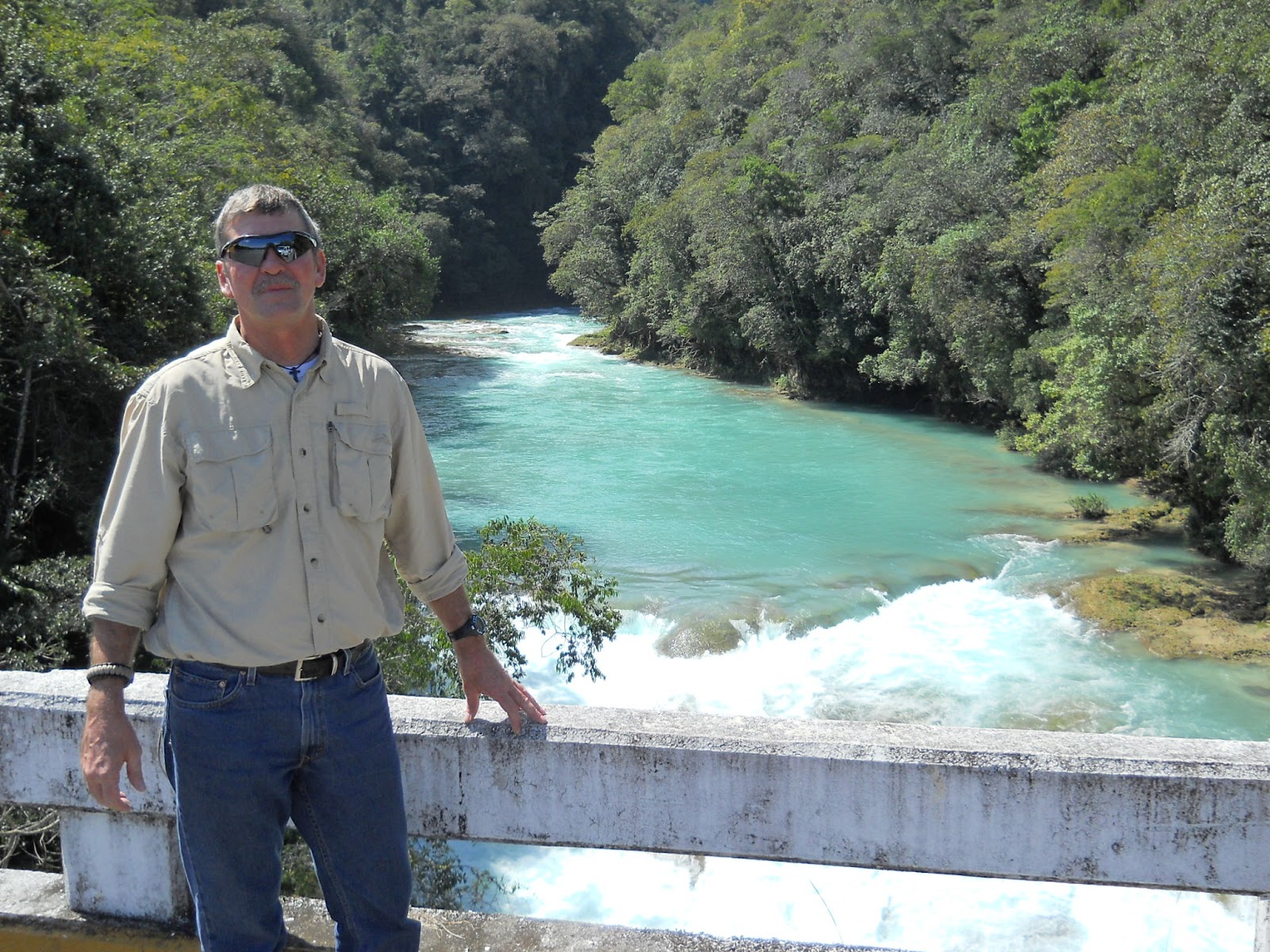
Once
we arrived to the village of Chajula, which is located along highway #307, I
wanted to take a short cut through some villages to hopefully shorten our
driving time for the day. Even though the road was merely dirt and contained a
lot of sections which were washed out by recent flooding, at times, I was glad I
made the decision for taking the short cut as we did. It made a difference in
driving time and we easily made it to the city of Benemeritos de las Americas so
we could refill the van with gas as needed. After refilling the van with gas and
buying some soft drinks and snacks, we went onward to visit the Maya ruins of
Bonampak to see the beautiful 1,200 year old murals that are there, which
completely cover the interior walls and ceilings of three of the structures at the site.
Before arriving there, we had to stop at the fifth military check point for the
day, and the soldiers made all of the men in our group get out of the van, put
our hands on the side of the van, and spread our legs. They were searching for
drugs and weapons, so they frisked all of us.

While
at the site, I noticed a large flock of parrots which flew over the main
plaza. They were squawking as usual and I could hear them coming from at least
1/4 of a mile away. Another pleasant surprise which I encountered while at the
site, was meeting one of my Facebook friends; Luis Adrian Rojas from Monterrey,
Mexico. He was part of another tour group that was also visiting the site
on this day. It was quite a coincidence to meet him at
Bonampak, for the first time in my life. As I had encountered during some of my
previous adventures, I never know who I am going to run across, while there.
Julio had never met him in person before either, but knew him quite well from
Facebook also.

After
leaving the site, we only had to drive through one more military check point
station, before arriving to the village of 'Once de Julio', where we would lodge for the next two nights at the ranch of Willy
Fonseca; Vallescondido. Arriving there just before dark, Willy was happily
waiting for us when we pulled into his driveway. He showed everyone in our group
to their cabins, and after we showered and rested up as needed, we were treated
to a wonderful dinner prepared by two of his workers.
Day
6 - Most of those in our group enjoyed the buffet-style breakfast at Willy's restaurant across
the road from his ranch. While at the restaurant, Willy had asked me which sites we had planned to visit
for the day. I told him I wanted to visit a couple of sites in the area, and he
told me that he had nothing to do for the day and would come along with us, if we
didn't mind. Heck, he even offered to drive the van, which I had no problem with
agreeing to. He asked me to wait for a few minutes while he and the cooks
at his restaurant made some sandwiches for our lunch later in the day. After arriving to the town of Frontera Corozal and paying the
mandatory fees as needed, we parked at the designated area along-side the
Usumacinta River and loaded up into one of the lanchas, to take the trip down
river to visit the Maya ruins of Yaxchilan. Along the way, we were thrilled to
see a scarlet macaw which was flying above, and also a crocodile
basking in the sun on a fallen log.

We
toured the site for around 2 hours and then made the boat trip back to
Frontera Corozal as needed, while we ate our lunch
along
the way. Once back at Frontera Corozal, we drove onward to the village of Plan
de Ayutla, where we had to pay a man for being granted access to visit the
desolate Maya ruin site of Sak Tzi, which is located on a cattle
ranch nearby. The site
was very nice and was surprisingly
restored
more than I expected. When we headed back
towards Willy's ranch, he wanted to show us some waterfalls nearby. I had no
idea where he was taking us, but when we arrived to the waterfalls of Las
Golondrinas, I was glad
we stopped to visit them. The waterfalls
are
very nice and people
are allowed to swim in the numerous pools
there
as well. Once
back at Willy's ranch, we were treated to another very nice dinner. It was also a
pleasure to meet Willy's son; Cesar, who was very helpful
with anything
we might need at times.

Day
7 - After breakfast at Willy's restaurant, again, Willy asked me what our plans were
for the day. I told him that the only plans that I had were to drive back to
Villahermosa, for turning in the rental van. He asked me if we were interested
in visiting a
couple of Maya ruin sites along the way, and if so, he would gladly come along
with us. He told me that he needed to go to Palenque anyway. Willy
first took us to the Maya ruin site of Chinikiha, where the Chilean
archaeologist; Rodrigo Liendo Stuardo was currently digging, with the help of
some Italian students. I never knew the site even existed, but of course Julio
knew about it. The site was nothing more than pasture land, but the students
showed us some of the artifacts they had uncovered while digging in the area.

We
left there and went onward to visit the Maya ruins of Pomona, which is located
in the state of Tabasco and is a very nice site to visit, even though it is
extremely small. While we were at the site, I did see a chocolate falcon behind
the pyramidal structure there, which I wasn't able to get a good photo of
while it was perched in a tree. The nicest thing about this particular
site, in my opinion, was the museum. It contained a large amount of
artifacts from the site and the building was very nice as well. Willy
drove us back to the city of Palenque and we decided to have lunch there at the
Maya Restaurant. The food was good and was reasonably priced as well. After
lunch, Willy departed for the bus station to go back to his ranch. Meanwhile, we
dropped Skip and Cleta off at their hotel, while the rest in our group drove
back to Villahermosa for turning in the rental van and checking into our rooms
as needed at the Hilton Hotel.

I
can't say enough good things about Willy Fonseca. While we were staying at
his ranch, there was hardly anything he would not provide for us, if he had the
ability to do so. Willy's son, Cesar, was very helpful as well and he can also
understand and speak a decent amount of English. The cabins were very clean and
nicely decorated. While we were there, the price for lodging per night was 1,350
MXN. Also, the buffet-style breakfast cost 80 MXN and dinner was 150 MXN per
person. One
other thing I would like to add is that Willy has wireless internet at his
ranch. Vallescondido is located at km. 61 on highway #307 in the village of 11
de Julio. Contact
info for Willy Fonseca -
email: busil_h@hotmail.com
& cell #
(011)
52
916
100 0399

Tuesday, March 27, 2012
The Lost Maya City of Los Olivos - July 2010

Note: This article was chosen to be in the October 2011 - June 2012 Volume 20, Issue 1-3 of 'The Codex'; a publication of the Pre-Columbian Society at the University of Pennsylvania Museum of Archaeology & Anthropology.
After more than a century of intensive exploration of Maya ruins in the steamy jungles of Guatemala’s northern region, one would think there would be little to nothing left undocumented. As I continue in my quest to visit as many ancient sites as possible, however, I am amazed at the quantity of unreported Maya sites I have encountered. During the past several years, I have made numerous trips to Maya sites in Mexico, Guatemala, Honduras and Belize. To my good fortune, I have established a network of fellow Mayanists and Guatemalan friends, with whom I have now explored many Maya ruin sites. Some of these sites are not even known to archaeologists. This brief report describes a visit to one such undocumented Maya site.
Even though I was not planning another trip to Guatemala until much later in the year, I changed my mind after receiving an email from my good friend, Dieter Richter, in which he told me that he had recently learned of the existence of a Maya site that had never been visited by anyone from the Guatemalan government archaeological agency, IDAEH, much less tourists. The site was near the small town of Dolores in the southern region of the Peten and according to Dieter, some people from the Guatemalan government had previously attempted to go there for surveying, and were chased out of the Kekchi Maya village of Los Olivos by the people there and were told to never return.

I was salivating at the idea of exploring a truly unknown Maya site, but Dieter cautioned me that many such ruins are located on private land and permission for access is not always granted by landowners. He also warned me that the Kekchi Maya people could be difficult to deal with at times, and that their looting of ruin sites and land use practices have done severe damage to the environments of the Peten. Dieter Richter is a German architect, who has lived in Flores for many years. He previously specialized in the restoration and architectural rescue of deteriorating Maya buildings at Maya ruin sites located in the “Triangulo Cultural – Yaxha, Nakum, Naranjo” project area of the Northeastern Peten. His experience and familiarity with the back-woods ruins is exceptional in a region that already has its fair share of eager archaeologists working at the many sites.
Dieter, however, is more than an archaeological architect; he owns and operates Café Arqueologico Yaxha, a unique restaurant, featuring walls covered with photos and maps of remote Peten ruin sites. He also operates a small tour company, called The Mayan Adventure that specializes in taking enthusiastic explorers to some of the little-known archaeological sites in the Peten region. Accompanying Dieter and I on the trip to visit the Maya ruin site was a young German man named Marc Eubel, who came to Flores for the sole purpose of taking Spanish lessons for a few weeks at Dos Mundos Spanish School.

After traveling to the town of Dolores with a man named Mito, we had a typical Guatemalan breakfast (huevos revueltos, frijoles and tortillas with coffee) at the house of Mito’s sister and brother-in-law; the Zitz Alvarado family. Mito’s brothers-in-law, Jorge Zitz Alvarado and Eber Neftali Quixchan joined our group, since Jorge had previously worked there and the Kekchi people knew him quite well. We departed for Los Olivos in a 4-wheel drive truck and drove 1 1/2 hours down a dirt road to reach the village, which is located extremely close to the Guatemalan border with Belize. Once we arrived, we were directed to talk with Marcos Choc, the owner of the village store as well as, the second chief of the village. The actual chief was not there, and Marcos was the man who made all of the community decisions in his absence.
At first, Marcos told us the ruins were on private land and he could not give us permission to visit the site, as it was not his land and the owner was far away and it would be impossible to contact him. I was sure to let Dieter do all of the talking, since he speaks fluent Spanish and is known by a lot of people in the area. My level of speaking Spanish is rather limited, but I understand a lot. We thought all along that they were currently looting the structures there and simply did not want us to go anywhere near the site, but could not be positive unless we actually caught them in the act. After nearly two hours of attempting to convince Marcos that we were simply Maya enthusiasts who only wanted to tour the site, Dieter decided out of desperation to boldly tell Marcos that we were going to see the site even without his permission, as we did not come all that way to simply go back to Flores.

Dieter then wrote a letter to the landowner, requesting of him to not be angry with us for entering his land without permission and included a payment of 100 Quetzales with the letter. This was Dieter’s way of testing whether Marcos would act aggressively toward us and chase us out of the village or allow us to visit the site as requested. Finally, Marcos told us he would go look for his brother, Jorge Choc, who turned out to be the landowner in question. Marcos had been lying in order to discourage us from visiting the site, hoping we would simply leave the village.
We were then escorted up a long and muddy horse trail to the top of the hill where we could see part of the ruin site from a distance. While there, one of our escorts, a young villager named Mario Caxan, told us that for every ceramic vase or vessel found at gravesites in perfect condition, they would receive as much as 10,000 Quetzales (about $1,200 USD) by selling it to a local buyer. Of course the local buyer would then sell it for much more to one of the countless private collectors around the world. We also learned that the landowners had not taken a shipment of looted artifacts to the local buyer in nearly two years, so one could only imagine how many artifacts were being kept in a storage building nearby.

While we were viewing the site as much as we could from outside a barbed-wire fence, Jorge Choc, Marcos and another man came from one of the platform structures to talk with us. The man was very dirty, from digging into a gravesite, so our assumptions were correct. We also learned that they were heavily armed in case someone tried to interfere with their looting of the artifacts. Dieter talked to them for a few minutes about things such as his restaurant in Flores and how his favorite soccer team, Germany, had blown the chance of winning another FIFA World Cup Tournament recently. Then Jorge Choc agreed to allow us to walk to the very top of the hill on his land where we could see additional structures.
Being quite certain that the people of the village had never seen any type of GPS instrument before and would probably think that I was simply using some sort of stop watch, I was sure to take out my Bushnell Backtrack for marking the site so I could find it in the future. By doing so, I could navigate back to the site from up to 999 miles away, and find out how far the site was from various locations in the area. The entire site was much larger than I had expected it to be and consisted of a specially located ball court, four very large platform structures located across a valley on top of high mountains, and an acropolis (the only part we were allowed to visit) that consisted of three plazas with palaces.

We were allowed to walk through the three plazas and found looter's tunnels that penetrated every structure on each side. Most of the structures in the plazas were nothing more than piles of rock, but there were some structural walls still intact. After touring the plazas, we were taken to another section of the acropolis, which was overgrown with small trees and bushes. It was in this particular area that the most preserved structure was located. Since I am tall, it was difficult to climb down and enter the doorway, but once inside, we could see it was still very much intact. The temperature was cooler inside than it was outside, and there was so much humidity in the air that we could see moisture dripping from the corbel-vaulted roof from condensation.
Once we were finished touring as much of the site as we were allowed to see, we were escorted back to the village store and bought numerous soft drinks from Marcos, considering we were quite thirsty and hot. I took off my shirt, which was drenched in sweat, and by doing so, inadvertently attracted the attention of the villagers who congregated around to see all 5 of my Maya tattoos. One of the villagers asked Dieter if I was in a gang or if I was a bad person and thankfully, he told them otherwise. Dieter, Marc and I were certain that we were the first “gringos” to be allowed to visit the site.

As we talked with Marcos while resting and enjoying our sodas in front of his store, we learned that the only white person who had previously visited the village there had been an Italian man, six or seven years earlier. I was amazed to know that some of the children in the village had never seen a white person, until we arrived that day. I never thought I would be fortunate enough to be able to experience such a thing myself, in this day and time anyway. I have visited a lot of different Maya ruins before Los Olivos, but that particular site will always be a special memory for me.
Subscribe to:
Posts (Atom)